
Tackling the mental health crisis head on
A movement of the UK's leading mental health charities to create a system for the modern day.

.svg)
Rates of mental illness are rising in our communities.
Over 10 times as many people are waiting 18 months for mental health treatment than for physical health.
Someone dies by suicide every 90 minutes.

Rates of mental illness are rising in our communities.

Over 10 times as many people are waiting 18 months for mental health treatment than for physical health.

Someone dies by suicide every 90 minutes
3 in 4
Britons believe the Government should do more to address mental health services.
90%
of donations go directly to programs


Why is this campaign important?
The mental health crisis is growing, and the system is failing people
The political urgency simply does not match the scale of need.
Delays in mental health treatment means people’s health deteriorates, families struggle, crises escalate, and costs rise. Entire lives are put on hold or lost.
It does not have to be this way.

"Living with emotionally unstable personality disorder is psychologically and emotionally taxing, and long waits for support only exacerbate the distress. Hope fades, often leading to crises that could have been prevented with earlier help. The cost of waiting wasn’t just time- it was stability, connection, and the belief that life could in fact improve."
Iona, expert by experience
What are we calling for?
A mental health guarantee backed by action
We are calling on Government to bring forward a new mental health guarantee, aligned with the NHS’s three stated shifts.
01
Treatment to prevention
Bring down mental health waiting times so no one is left waiting months – or years – for help. Long waits have been normalised. Mental health deserves time standards that work.
02
Hospital to community
Roll out neighbourhood mental health hubs in every area, including 24/7 mental health centres. Care should begin in communities – not only in crisis, and not only in hospital settings.
03
Analogue to digital
Rapidly trial and roll out safe, evidence‑based digital treatments. Seven NICE‑approved digital interventions already exist, yet they are barely being used. This must change.Together, these actions would begin to create a modern mental health system that meets today’s needs instead of reacting to yesterday’s crises.
Ambassadors
The people standing with us

Shocka
Shocka is a rapper, author and mental health advocate who uses his platform to encourage honest conversations around mental health, recovery and resilience. Across music, writing and public speaking, he brings lived experience, compassion and credibility to the conversation.
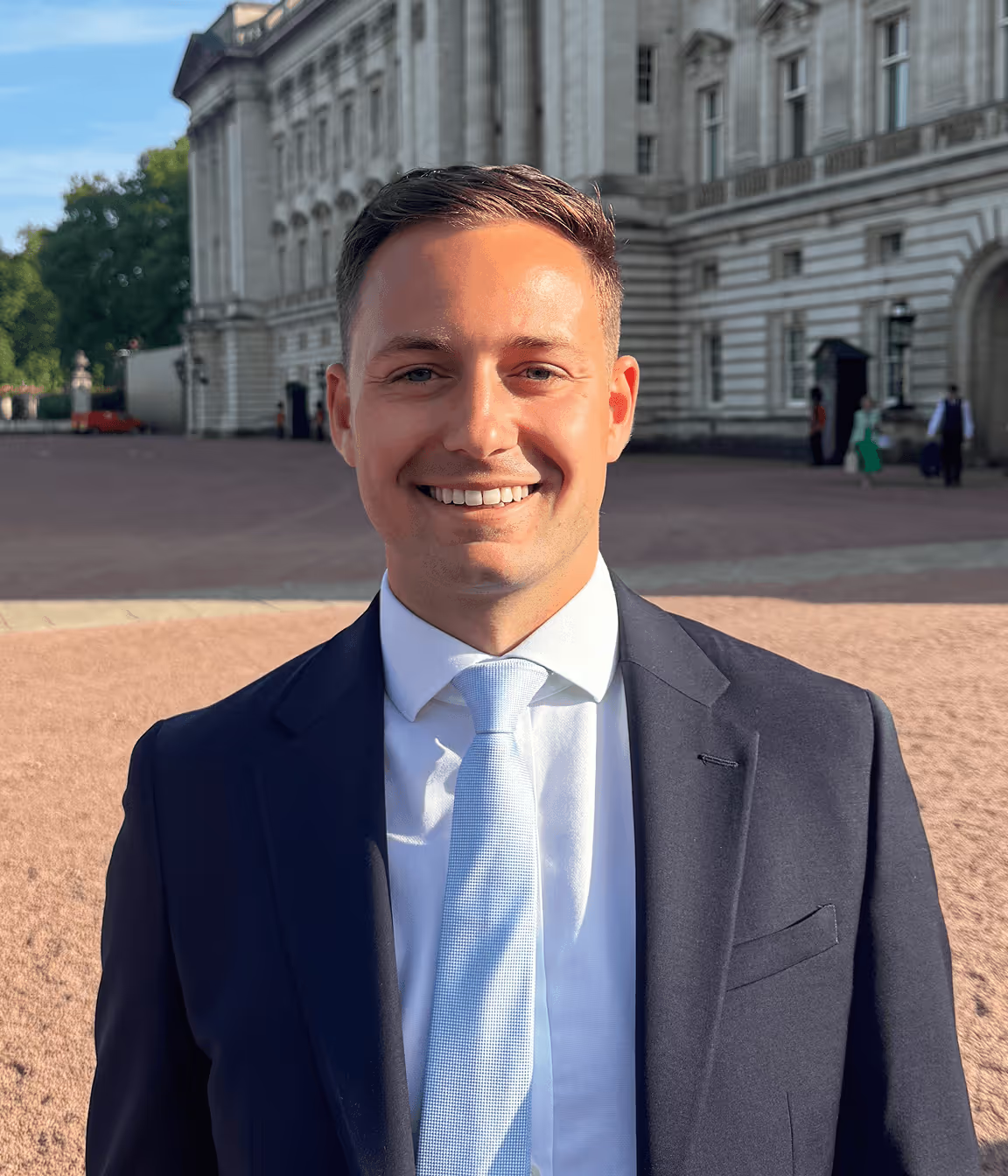
Ben West
Ben West is a mental health campaigner, author and speaker who has become one of the UK’s most recognisable voices on suicide prevention and mental health reform. Driven by personal experience, he campaigns for practical change, especially in education, and uses his platform to push for earlier support and lasting action.

Ambassador 3 Name
Lorem ipsum dolor sit amet, consectetur adipiscing elit. Suspendisse varius enim in eros elementum tristique. Duis cursus, mi quis viverra ornare, eros dolor interdum nulla, ut commodo diam libero vitae erat. Aenean faucibus nibh et justo cursus id rutrum lorem imperdiet. Nunc ut sem vitae risus tristique posuere.
Reasons to be hopeful
We know better help is possible
Eating Disorder Intensive Service

The Eating Disorder Intensive Service (EDIS) shows what becomes possible when community‑based mental health support is properly prioritised: fewer hospital admissions and better outcomes for young people and their families.
Delivered by the Royal Free London NHS Foundation Trust, EDIS provides intensive support for children and young people who aren’t progressing in community treatment or are at risk of being admitted to hospital. The service operates seven days a week, offering face‑to‑face care, home visits, and digital support to make treatment more accessible.
This approach enables young people to stay at home, continue to attend school, and receive tailored multi‑disciplinary care that adapts in intensity as their confidence and skills grow. Families and carers are central partners throughout the process.
From April 2022 to March 2024, EDIS treated 78 young people assessed as being at risk of requiring specialist inpatient admission. Remarkably, just 17% ultimately needed admission. Satisfaction with the service was extremely high, with more than four in five patients recommending it.
Learn more about the EDIS here.
Open Mental Health
In just a few years, Open Mental Health has grown from a shared vision of mental health support for everyone, to a joined-up set of accessible services across Somerset. Guided throughout by experts by experience, watchwords like ‘no wrong door’ and ‘warm transfers’ have become a reality.
The Open Mental Health alliance is formed of nineteen voluntary, community, faith, and social enterprises working in close collaboration with the NHS and Somerset Council.
The services offered include specialised mental health services, housing and debt guidance, community activities and physical exercise. This collaborative, partnership-based approach has created real impact:
35% drop in acute hospital stays – creating £6.1 million in savings
- 18% reduction in mental health inpatient admissions
- 4% mental health readmission rate – half the national average
- 15% reduction in A&E attendances
This means that people in Somerset are getting the right response and support, in the community when they need it.
Learn more about Open Mental Health here.
Neighbourhood Mental Health Centre
We know that timely access to mental health support close to home can be the difference between recovery and crisis for people living with severe mental illness.
What people tell us, and what evidence shows, is that the most effective support is wraparound: providing access not only to clinical care and treatment but also to support with housing, employment, and building social connections.
These factors can be powerful in preventing relapse and supporting recovery, but when absent, someone’s mental health can significantly worsen. The East London Foundation Trust’s Community Mental Health centre brings together clinical teams, voluntary sector partners and peer support workers to provide mental health input when people need it – to help prevent people becoming very unwell and needing to be admitted to hospital.
Within 6 months of opening, the Barnsley Street Community Mental Health Centre has seen:
- 45% reduction in acute ward admission in areas of Tower Hamlets
- Length of stay reduced
- Improved community engagement with ‘did not attend’ rates dropping from 18 to 13%
Learn more about the Barnsley Street Community Mental Health Centre here.
AVATAR therapy
For many people who hear voices, auditory hallucinations can be distressing, especially when voices are critical or abusive.
AVATAR therapy has been developed to provide people who hear distressing voices with the tools to confront their main voice along with therapeutic support. A digital avatar is created that looks and sounds like the voice, and a therapist communicates through the avatar, making the sort of negative statements that the person hears.
A randomised control trial of 345 people was conducted in 2024, testing the impact of the brief (six sessions) and extended (12 sessions) versions of AVATAR therapy against a usual antipsychotic medication. The study found: AVATAR therapy is a promising development that may help to alleviate the negative effects of voice hearing and empower people to take back control. The National Institute for Health and Care Excellence (NICE) have recommended that AVATAR is used in the NHS while researchers continue to gather real-world evidence of its effectiveness in clinical practice. The project team hope that the evidence gathered will enable a wider rollout in the NHS within the next five years.
- Participants who received either the brief or extended version of the therapy saw significant improvements in the severity of the voices heard and distress felt;
- Participants who received the extended version saw stronger and more sustained effects over time, with a reduction in the occurrence of voices.
Learn more about AVATAR therapy here.
Cobenfy
Cobenfy is the first new medication for schizophrenia in several decades. It works in a different way to other antipsychotics as it combines two different medications (xanomeline and trospium chloride) and targets different receptors in the brain.
It is an exciting development as while existing antipsychotics can be a lifeline for many, they do not alleviate symptoms for everyone. Alternative treatments are desperately needed.
The Phase 3 trial of Cobenfy conducted in the USA in 2024 showed: While Cobenfy has been approved for the treatment of schizophrenia is the USA, it has not yet been licenced for use in England. Bristol Myers Squibb is currently pursuing this with the Medicines and Healthcare products Regulatory Agency (MHRA) and hopes to launch Cobenfy in the UK in 2026.
- Statistically significant improvements in symptoms of psychosis (e.g. delusions and hallucinations), compared to a placebo.
- Fewer negative symptoms of schizophrenia (e.g. lack of motivation, social withdrawal, and cognitive impairment).
- Fewer of the side effects commonly caused by other antipsychotics (e.g. drowsiness, weight gain and abnormal motor movements).
Learn more about Cobenfy here.
Centre 33: Cambridgeshire and Peterborough's Early Support Hub
Centre 33 demonstrates what’s possible when early, open-access mental health support is properly integrated with NHS services: faster access, fewer long waits, and more young people getting the help they need, when they need it.
Delivered across Cambridgeshire and Peterborough, Centre 33 provides safe, inclusive and holistic support for young people aged 13–25, without the need for referral. It offers confidential one-to-one support for both emotional and practical needs, alongside routes into additional support such as counselling.
In 2021, Centre 33 became part of YOUnited, a partnership with Cambridgeshire & Peterborough NHS Foundation Trust and Ormiston Families. Together, they co-deliver an integrated referral hub: a single “front door” for children and young people aged 5-25 to access mental health support.
Within this model, Centre 33 applied Single Session Thinking – an approach that aims to make a person’s first contact with services as meaningful as possible, on the basis that it might be the only one. As a result:
- The waiting list for young people waiting for their first contact with services dropped by over 95% (from 750 to approximately 25)
- The percentage of young people requiring an onward referral for additional support dropped from 82% to 44%
This indicates that, when done well, many young people’s mental health needs can be met safely and effectively through one or two timely, tailored sessions. This reduces pressure on specialist services by helping more young people get the support they need before they reach crisis point.
.
Learn more about Centre 33 here.
Creating a Mentally Healthy City in Birmingham
Birmingham demonstrates the potential of embedding mental health into local policy and services: stronger prevention, earlier intervention, and coordinated action to improve wellbeing across the population.
Through its Creating a Mentally Healthy City strategy, Birmingham City Council is leading a city-wide, partnership-based approach to mental health and wellbeing. The strategy takes action on the factors that shape mental health: what increases risk and what protects against it.
Delivered through the Health and Wellbeing Board and wider partners, this whole-system approach ensures mental health is considered in local services and decision-making. This includes community-based support, family and school settings, housing, workplaces, and public health.
The strategy is designed to deliver long-term change across the city:
- Improved mental wellbeing, resilience and mental health literacy
- Reduced loneliness and improved social connection
- Better, more equitable access to support and improved recovery
- Reduced hospital admissions for self-harm and lower rates of suicide over time
This highlights what putting mental health at the heart of policy and services can do: boost wellbeing, prevent harm, and tackle the root causes of mental health problems.
Learn more about Birmingham City Council - Creating A Mentally Healthy City strategy here.
“For people from underrepresented communities the journey to support can already be shaped by silence, stigma, mistrust and inequality before the waiting even begins. When support is timely, inclusive, and responsive it can change far more than symptoms, it can change whether someone feels able to ask for help at all.”
Expert by experience
Our Impact
Real Impact, Real Change

4,200+
Children Supported
Children Supported
Providing direct support through education, health, and protection programs.

35+
Community Partners
Community Partners
Providing direct support through education, health, and protection programs.


90%
of donations go directly to programs
of donations go directly to programs
We prioritize transparency and efficiency, ensuring the majority of every contribution directly supports children and the programs designed to improve their lives.
Who we are
The Head On Campaign is led by a coalition of over 20 leading UK mental health charities, united by a shared belief: the current system is not good enough and we can fix it.
We bring frontline expertise, lived experience, and practical solutions. Our focus is simple: what works, what’s needed, and what must happen next.
Reimagining mental health for the future starts now.
Let’s tackle it Head On.






.avif)


Sarah Mitchell
Program Lead

Daniel Carter
Community Partnerships

Rose Richard
Health & Well-Being Coordinator

Lucas Bennett
Operations & Accountability
Stories
Real Stories

“My child feels safe and excited to learn again.”
— Parent

“Carevia makes support feel personal and meaningful.”
— Donor

“We see real change happening in our community.”
— Community Partner

“Small actions here create long-term impact.”
— Volunteer

“Support reaches families who really need it.”
— Parent
“Transparency is why I continue to support Carevia.”
— Donor

“The programs truly put children first.”
— Community Partner

“It feels good to be part of something that matters.”
— Volunteer
Help us tackle the mental health crisis head on

Support the campaign
Share our campaign film and help build the pressure for change.

Become a partner
Join a growing coalition of charities, organisations, businesses and innovators working towards a better mental health system.
Contact the team today
.svg)
Join the campaign
If you are an MP, policymaker or decision‑maker, stand with us. Champion the mental health guarantee. Help deliver reform at speed and scale.
Get in touch here
Shaping the future of mental health must be a collective effort, and leadership matters.